
Overview
- Role
- Game Designer and Lead Developer
- Team
- Team Kinkajou (Myself, Ana Gusson, Larissa de Andrade, Ian Tang, Shishun Feng, and Maria Caraballo)
- Context
- Master of Digital Media, Centre for Digital Media
- Duration
- September 2025 - December 2025
- Engine & Tools
- Unity
- Status
- Finished
How It Plays
Lumiètrique is a 2.5D puzzle platformer where you control three robots, each with a different ability: Dasher dashes through lasers, Jumper clears platforming sections, and Flyer crosses gaps. Stack them, and the bottom robot decides how the stack moves, so Dasher on top of Flyer can fly. Split the robots up to complete circuits, then combine them to reach places none could alone.
You play as Dr. Georges, a scientist trapped in a malfunctioning robot body after a lightning strike interrupts his consciousness-transfer experiment and scatters his helper robots across the lab.
The Pivot
This game started its life in a very different capacity to how it ended up. Originally, it was a 2.5D platformer with an Ancient Egyptian theme called Duat Bound.
The main mechanic of the game was that the player could switch between two worlds and had to do so to overcome platforming challenges. The game was to be quick and intense (think Super Meat Boy), where the player must leap between a gap, switch worlds in the air, and land on a platform in the other world. Possession was also an aspect of the game, where switching between worlds while over the body of another being would cause you to inhabit that being (e.g., possessing a bat would allow you to fly temporarily).
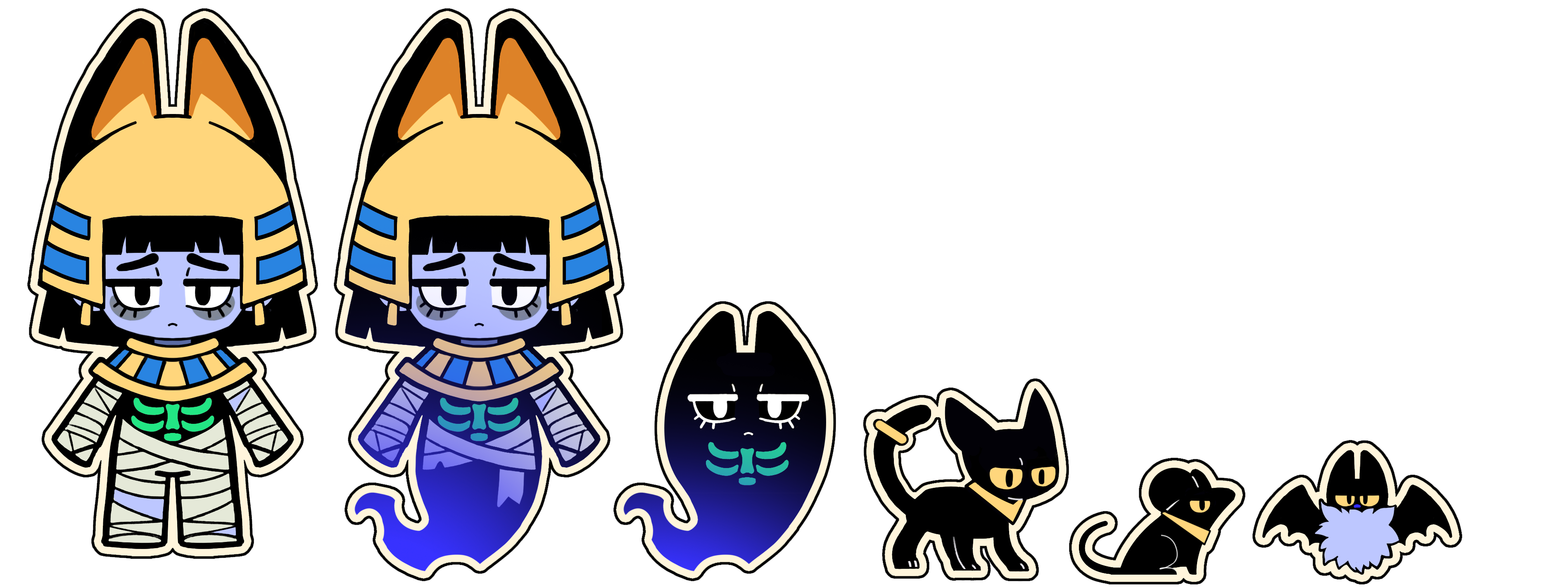
Split between the living and the spirit worlds, play as Neferu, a lost soul who must use the powers of the Duat to manipulate the world of the living (Kemet). Journey through ancient Egypt, solve the mystery of your body’s disappearance, and reunite your soul and body to earn your passage into the perfect afterlife of Ma’at.
Around the ⅔ mark of the project, we received a major mandated pivot in the form of a publisher brief. The document indicated that we should keep the possession puzzles, but drop the Egyptian theme for pastel retrofuture, add randomly changing abilities, electrical transference, and chain reactions.
Publisher Brief
Decisions
With not long left in the project, we needed to address the brief but also balance its requirements with where we were at development-wise and time-wise. What we came up with was Lumiètrique, a 2.5D puzzle platformer with a pastel retrofuturistic theme where the player controls three of Dr. Georges’s helper robots.
The core mechanic of this new game was that the robots are able to stack on top of one another, where the bottommost robot controls the type of movement of the stack. For example, if you stack Dasher on top of Flyer, you can now fly with Dasher to a new location. This is what the possession puzzles and changing abilities became.
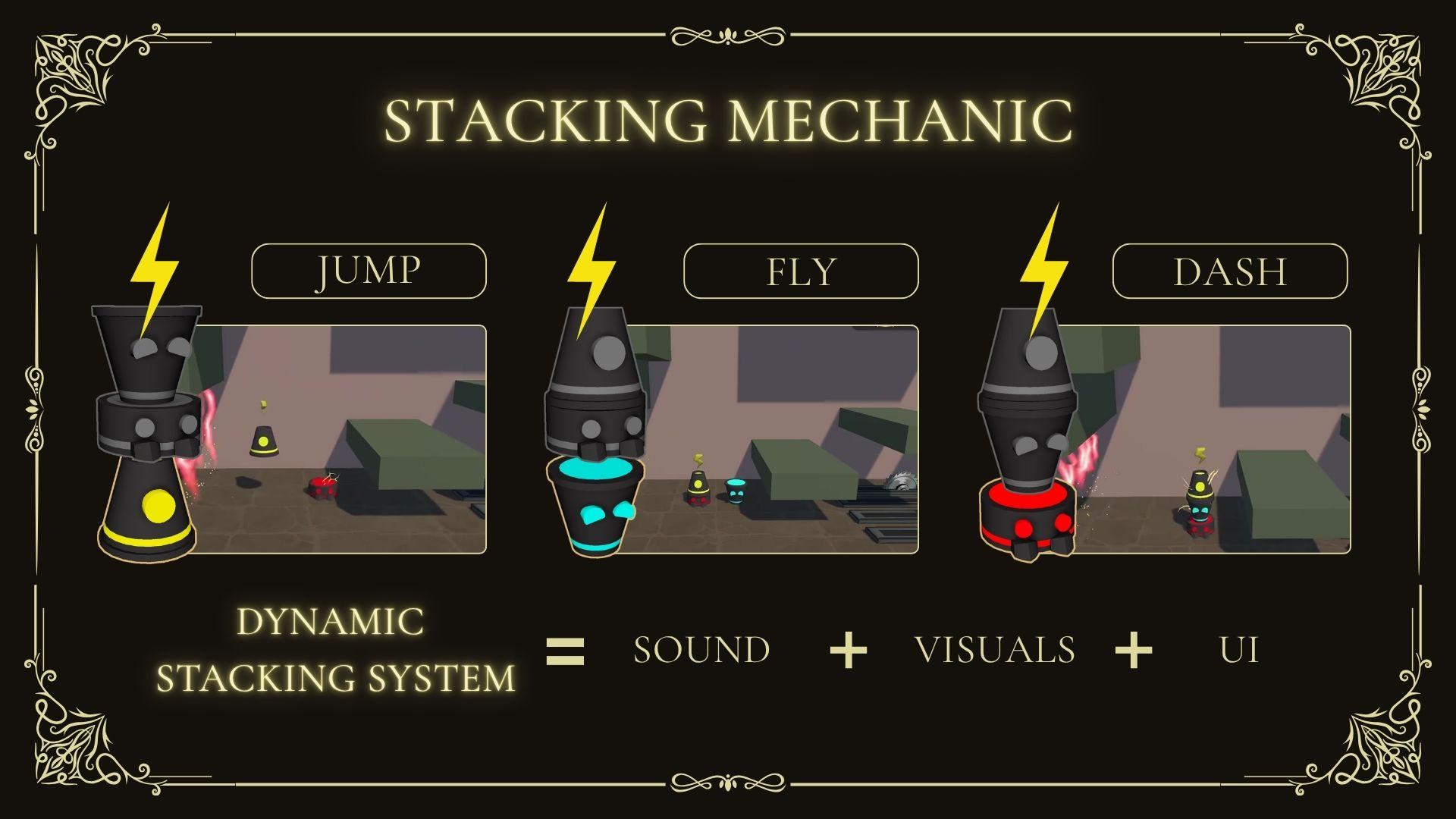
This opened up some interesting directions in level design, and we added the concept of electrical transference in the sense that you need to do divide-and-conquer-style problem solving to complete circuits in order to open doors and progress through the game. Circuits also gave us a way to address chain reactions: completing one could power the next, so a single solved puzzle could set off a sequence of changes across the level.
Iteration
The biggest thing that was iterated upon many times was the stacking system. There were many major and subtle design questions that needed to be answered in order to implement the system into the game. Do the robots need to be on top of each other to stack, or can they just be near one another? Should players be able to switch between robots at will? How does that impact our level design? How do we make it feel satisfying and engaging?
The answers to these questions came through many iterations. We landed on robots needing to be near each other to stack, which decreased the frustration of having to align them. Players can switch at will such that one robot can do something on one side of a level while another is elsewhere. A smart camera system tracks the player, and the stacking comes with satisfying pop and snap SFX to get the feel right.
There were also many code architecture questions and iterations here. How can I ensure the code can handle a singular robot stacking on top of a stack as well as a stack stacking on top of a stack? Alternatively, a stack stacking on a single robot? How do I make sure the robots go to the right spot height-wise when stacking if we have robots that are of different heights? The code architecture had to be robust to handle the many possible variations, so I worked really hard to implement it in a manner that complemented the design constraints and requirements.
Outcome
After the pivot, we had three weeks to rebuild the game around a new theme and new mechanics. We shipped two fully playable levels that introduce the robot-stacking system and addressed our new design brief.
The game was well received at an open event for game projects within the CDM, with players often returning to solve the game’s puzzles. Several players replayed the second level multiple times looking for alternate solutions.
The robot stack mechanic reminds me of a game from my childhood, I love it. Brings back good memories.
This game was challenging but fun to make. It put me onto a team where I was heavily outnumbered discipline-wise. I was the only one with a background in game design and development, with the rest of the team being artists with backgrounds in other forms of media. Being made up of artists primarily, the team had a tendency to want to focus on the art-style and story in lieu of the gameplay. As such, I had to adjust the way that I communicated and thought about the game’s design. For example, my communication of the design of the stacking system with Ian, our concept artist, was particularly vital to the outcome of the game because it meant that we would have the characters designed with the system’s constraints in mind. I needed to take ownership over the gameplay and development in order to ensure that progress was being made on that front and in parallel to the development of the story and art. Thus, I learned to separate the core mechanic from its theming, while keeping them working in parallel. Overall, it was a fantastic learning experience with some very talented team members, and my game design instincts developed greatly from it.