Overview
Brawl Stars is a multiplayer mobile live service game, with top-down MOBA-like gameplay. The game currently features 104 different characters (called “Brawlers”), each of which fit into one of seven character classes, with each class showcasing a different gameplay style. Those classes are: Marksmen, Artillery, Assassins, Tanks, Damage Dealers, Controllers, and Support. These Brawler classes have a rock-paper-scissors style system underneath, whereby certain classes are strong/weak against others (e.g., Artillery Brawlers are strong against Marksmen and Damage Dealers but weak against Tanks and Assassins). Each Brawler has a basic attack with a recharge-based ammo system, and a unique “Super” ability which is charged by dealing damage to opponents (e.g., my most played Brawler was Tick, an Artillery Brawler, and its Super is to launch a homing bomb that will target the closest enemy). Each of the basic attacks and Supers have a cooldown, and thus the core gameplay is built around these things in positioning, cooldown management, and aim.
The gameplay is focused on short, bite-sized matches that range from 2 to 3 minutes long across a rotating suite of game modes and maps. There is a large variety of game modes with differing goals and formats. For example, there are 3v3 team battles, 1v1 duels, 10-player Solo/Duo/Trio battle-royale style showdowns, as well as game modes such as Gem Grab and Brawl Ball where the focus is not solely on defeating the other team(s), but instead on completing an objective such as grabbing as many gems as possible or scoring goals. Players can queue with automated matchmaking to find teammates, or team-up with their friends by inviting them into their party.
As a live-service title, the game has many features meant for long-term player retention. Players can earn resources via gameplay, through the seasonal Battle Passes called “Brawl Pass” (of which there are two), as well as complete the linear “Starr Road” progression track to unlock different Brawlers. Brawlers can be upgraded using the in-game currency to increase their base stats, and they can be customised using various modular items such as Gadgets (which are button-activated abilities completely unique to each brawler) and Star Powers (which act as permanent passive perks). The game also features social elements such as friends and “clubs,” which act in a similar way to clans in other live service mobile games.
Game Systems
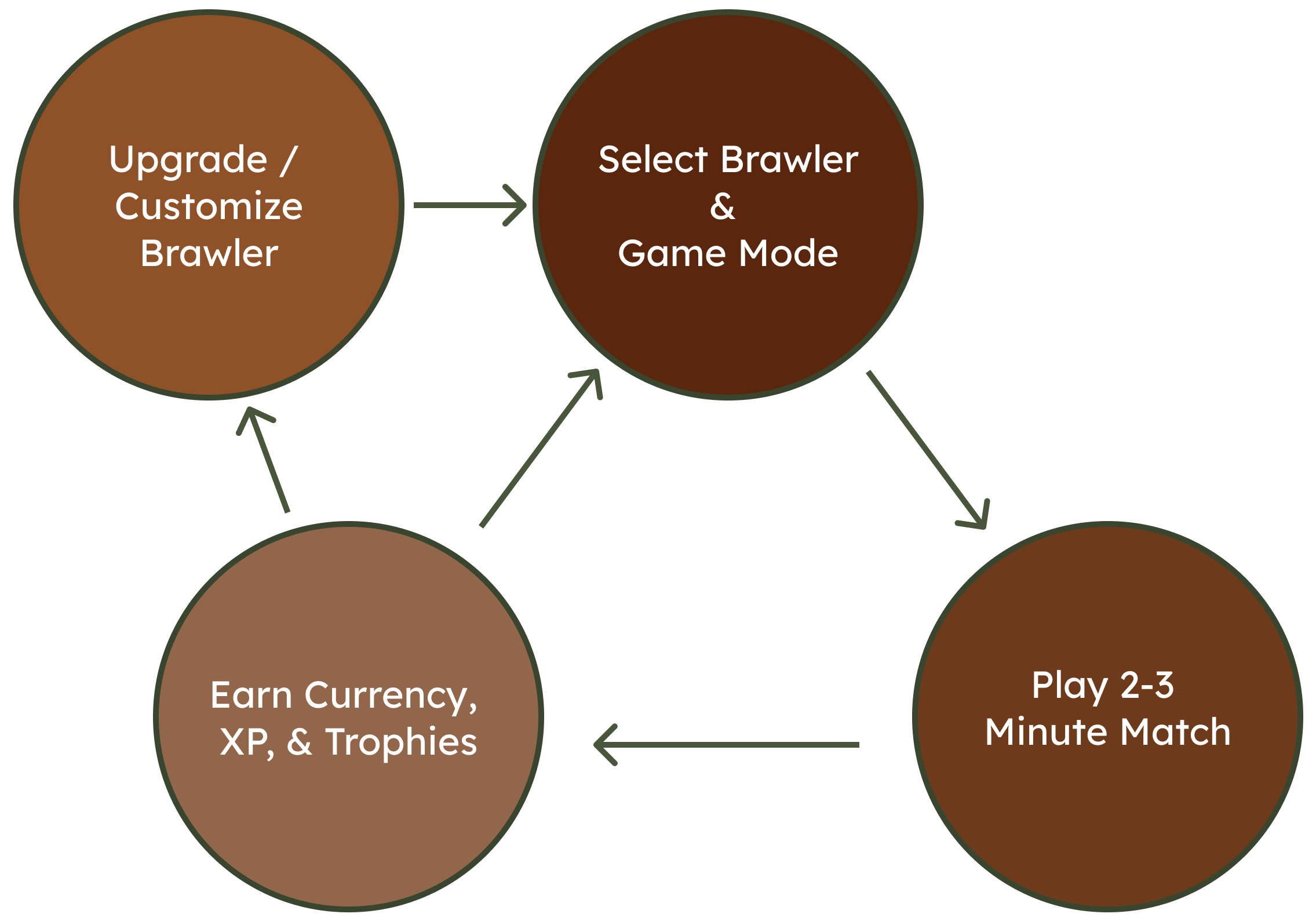
Core Loop
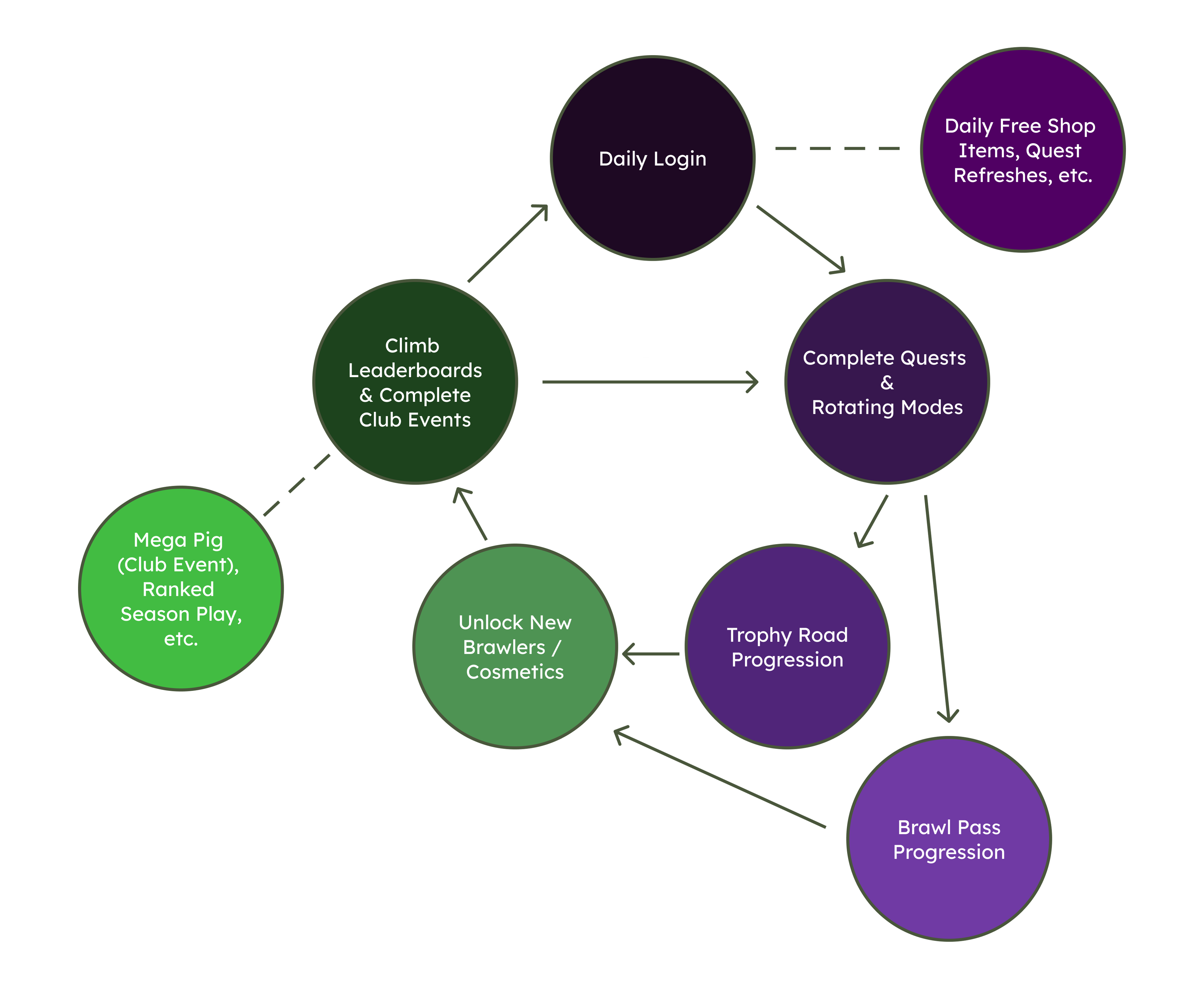
Retention Loop
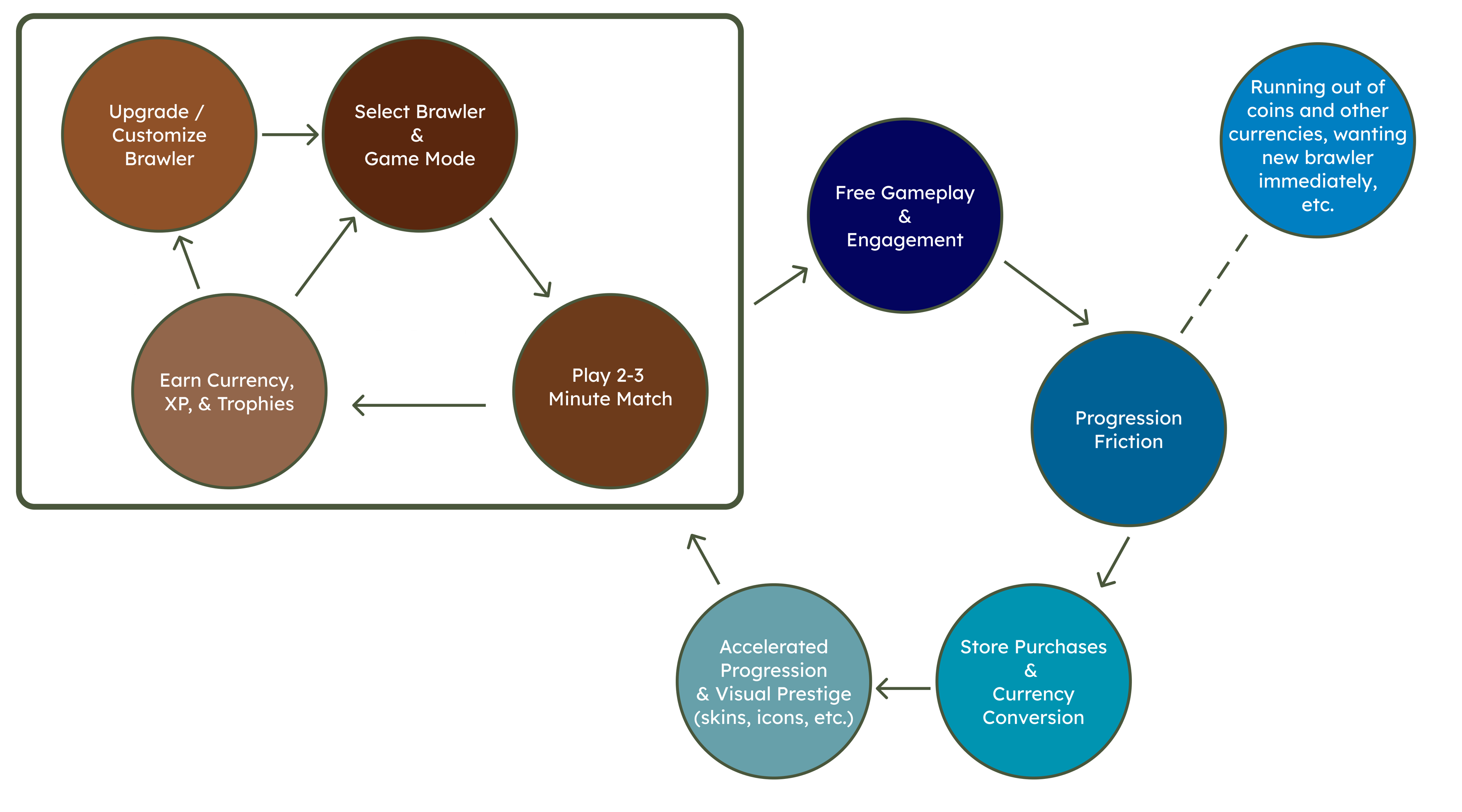
Monetization Loop
What Makes It Successful
- Brawler variety: At the time of writing, there are over 100 Brawlers available (104 to be exact). Each of these Brawlers has a unique moveset, as well as unique skins, gadgets, star powers, etc. The game isn’t lacking content in that regard, and it constantly incentivises you to try new Brawlers and game modes.
- Gamemode variety: it’s a bit hard to pin down exactly what the game is. The best description in terms of genre is a MOBA-lite, which does encapsulate the style of gameplay, but not the range of game modes available. The fact that it has so many game modes to draw on and rotate through, coupled with the Brawler variety, gives it the evergreen content that such a live-service game needs.
- Per-Brawler Progression: Everything progresses on a per-Brawler basis rather than having a single account-wide rank. This eliminates the anxiety of losing global rank just because you want to try out a new Brawler.
- Per-Brawler Customisation: There are multiple unlockable and customisable elements per-Brawler as well, including battle-cards (i.e., your in-game portrait which includes titles, stickers, icons, and backgrounds), skins, upgrades (Gadgets, Star Powers, Gears, and Hypercharges), etc. This adds depth and connection between the player and their Brawlers.
- Match & Session Length: Matches are capped at 2 to 3 minutes, which minimises the player’s commitment. It also makes you have that "just one more match" attitude since the matches are so low-commitment and quick, which often keeps you in the game longer than anticipated.
- Accessible Control Scheme: The control scheme is very accessible in that it is simple and pretty much the same for each Brawler. The left stick moves you, the right stick fires your basic attack, and there can be other buttons present that fire your Super and other attacks (depending on what’s been unlocked for that Brawler).
Competitive Analysis
Pokémon Unite
Pokémon Unite is a free-to-play MOBA. The game is cross-platform and playable on mobile (iOS and Android) and the Nintendo Switch 1 & 2. The game features a roster of playable Pokémon, each of which is categorised into one of five distinct battle roles (Attackers, Speedsters, All-Rounders, Defenders, and Supporters). The battle role-dynamic is less like the rock-paper-scissors of the mainline Pokémon games and more to do with gameplay styles (for example, a Speedster character with better speed stats may sneak around the back of a lane to catch an opponent off guard). Each Pokémon has standard attacks, two customizable active moves, and a “Unite Move,” which are powerful moves that can be charged over the course of the game.
The main match format has a strict 10-minute timer, and the goal of the game is to score goals in your opponents zones rather than purely accumulating kills. Two teams of five compete on a map with 3 lanes (top, central, and bottom) and try to gather “Aeos Energy” to deposit into the enemy goals. The Aeos Energy can be gathered primarily in two different ways: by killing non-player Pokémon that are littered around the map, and by killing opponents and stealing their Aeos Energy. The game offers several match formats, including the standard 5v5 casual battles, a competitive ranked league, a faster-paced 3v3 mode, etc. Players can enter matchmaking solo or as part of a pre-made team with up to 4 friends.
By playing the game, players will earn currency and other rewards. Players can also choose to purchase the seasonal battle passes, which net them more rewards and new Pokémon licenses (which let you play as a given Pokémon in battle). The game features an interesting licensing system, where you may play as some Pokémon permanently if you unlock their Unite License or temporarily if you only have that Pokémon’s Limited License. The game also features robust social features (e.g., Unite Clubs), player profile customization (including player avatar/trainer customization).
Bullet Echo
Bullet Echo is a tactical top-down shooter and battle-royale style mobile live-service game developed by ZeptoLab. The game has a relatively small roster of ~30 “Heroes,” each categorized into one of five classes (snipers, tanks, troopers, scouts, and ambushers). There is no rock-paper-scissors style system here, so these classes are entirely based on gameplay mechanics (e.g., tanks have higher HP, scouts are faster, troopers are in the middle of tanks and scouts, etc.). Unlike traditional top-down shooters, shooting in Bullet Echo is entirely automated. Players can manually control their movement and position, and must sometimes reload, but their character automatically fires whenever an enemy hits their directional flashlight cone. Players cannot see outside their active field of view (their flashlight cone), but they can see an enemy’s footsteps if they are within a certain radius around the player.
Matches are very short and fast-paced (~1-3 minutes). The main format is a 3-player squad battle royale, where players must take down other teams, but there are also other formats like king of the hill solo matches, team deathmatch, etc. Matches begin with players spawning without equipment, so they are forced to quickly scavenge the map for ammo, health kits, armour, etc. Players can queue solo with random teammates or create a lobby with friends.
Players can earn new Heroes, gold, dollars, and other rewards through daily missions and match chests (as well as the game’s seasonal battle pass) in order to rank up their heroes’ base power, health, and passive skill abilities. Hero builds are further customized through collectible Gear pieces that grant set bonuses and stat modifications. The game has social features much like the other two games such as syndicates (clans), syndicate events, league rankings, event-exclusive game modes, and more.
How It Differs
The three games are of course inter-related, but they are also quite distinct from one another. If you take the top-down moba-like gameplay of Pokémon Unite and the quick match sizes and character customizability of Bullet Echo, you would have something like Brawl Stars. So, in that sense, Brawl Stars differs from Pokémon Unite in that it has a different approach to playable characters than Pokémon Unite (e.g., in Brawl Stars, character unlocks are always permanent, in Pokémon Unite, they’re not; Brawl Stars has rock-paper-scissors-style class mechanics, Pokémon has gameplay-oriented class mechanics, etc.), and a different overall approach to gameplay than Bullet Echo.
Brawl Stars vs. Pokémon Unite
- Progression Differs In-Match vs. Out-of-Match: In Brawl Stars, stats are completely fixed within a match. Every player enters the match with an assigned power level and pre-equipped gadgets, star powers, hypercharges, etc. and keeps those stats from start to finish (although, in some game modes you can upgrade your health within a match). Pokémon Unite has a more traditional MOBA attitude towards in-match progress, where characters start at level one and must actively farm the wild Pokémon around the map or kill enemies to evolve, and unlock and upgrade abilities in real time.
- Aiming Controls: In Brawl Stars, you have to manually aim to shoot, which adds more skill around that area of combat. In Pokémon Unite, attacks are targeted via lock-on mechanics and directional cones (e.g., for some moves, if an enemy is within that cone when you press the button, it will auto lock-on and damage them).
- Session and Match Length: This is maybe the biggest difference between the two, Brawl Stars has very short 2 to 3 minute matches with sudden-death formats. Pokémon Unite has a 10-minute timer for standard matches, which creates a much longer time commitment per session for the player.
- Win Conditions & Scoring: Brawl Stars has a lot of different win conditions depending on the game mode format (e.g., kill all other enemies, eliminate all other teams, score more goals than other teams, holding a hot zone, collecting the most gems, etc.), whereas Pokémon Unite centers entirely around scoring in enemy goal zones across lanes.
Brawl Stars vs. Bullet Echo
- Map Visibility: In Brawl Stars, players have a full, overhead view of the arena at all times within their screen real estate (unless an enemy player steps into a bush, at which point they are hidden from the player). Bullet Echo on the other hand completely restricts the player’s view to a flashlight in front of them and some information in a limited radius around them (e.g., footsteps of enemy players).
- Combat Automation: Brawl Stars requires full player input for every action, whereas Bullet Echo automates the firing of the weapon. Interestingly, that is inverted in how they handle reloading: in Brawl Stars, reloading is automatic, whereas in Bullet Echo, reloading must be done manually.
- In-Match Loot: Brawl Stars matches begin with each player fully armed and ready to fight immediately, whereas Bullet Echo spawns players unequipped apart from their gun, and makes them scavenge for ammo, armour, medkits, etc.
- Cosmetic Purchases: In Brawl Stars, there is a menu for each brawler, but the only skin available for each one is the "True Silver" skin which costs 10000 coins and is just a silver reskin of the main skin (at least that I can see, perhaps if you progress further into the game this expands more, but nothing I did seemed to change it). Bullet Echo also lets you buy character skins from a unique menu for each character, which is slightly better as there seem to be more options (but having said that, most of those skins do say things like "must be won from an event").
Key Differentiators
- Brawl Stars: Differentiates itself through bite-sized, high-variety sessions and per-Brawler rank tracking. Rankings are isolated to individual characters rather than an account-wide MMR like other MOBAs, which removes the anxiety of being ranked down just for experimenting with a new character and thus encourages players to explore the massive character roster.
- Pokémon Unite: Differentiates itself through in-match RPG leveling and evolution mechanics tied to its own IP (e.g., if playing as Umbreon, you must first start the match as Eevee before evolving). The game thus really works narratively within its own IP. It also differentiates itself in that the core game has quite a bit more depth than its competitors in the mobile space in that it more closely resembles a MOBA rather than a MOBA-lite.
- Bullet Echo: Differentiates itself through the flashlight directional visibility mechanics. The gameplay is more focused on positioning and stealth than its competitors, which traditionally focus more on aiming skills and stat matchups.
Where Each Excels
- In-Match Strategic Depth: the 10-minute match structure better allows for strategic depth than Brawl Stars. Each match has a clear early-game, mid-game and end-game, and it feels like the decisions you make during those points (e.g., which lane to push, which goals to focus on, when to defend, how you approach the center boss fights against legendaries like Groudon or Zapdos as a team, etc.) really change the outcome of the match.
- IP Leverage & Narrative: It’s difficult to compare other IPs to Pokémon because it can feel unfair, it’s one of, if not the most, well known IPs in the world. However, I feel like Brawl Stars does a bad job narratively in that I don’t really know what the whole IP is about. The characters and designs all feel a bit random, it’s just a mishmash of stuff without any coherent thread connecting it all, which makes it harder to connect with the characters.
- Session Length: I think the developers were in a trick spot with Unite in that they had to consider both mobile and the Switch, the latter of which is usually played for a longer amount of time. I wouldn’t just pick up my Switch to play a short 2 minute round like I would my phone. Also, if a match goes poorly in the early-game, you’re locked into that round for the rest of the session. Whereas in Brawl Stars, even if you get steamrolled, that match is done within a 2-3 minute window.
- Cluttered UI and Meta-Progression: I was very excited when I first started up the game, it seemed pretty clear going through the tutorial, and I’m a big fan of Pokémon, but then I saw the UI. The main UI in this game is completely overwhelming, and I was showered with a bunch of rewards that I had no idea what they did. Brawl Stars is comparatively better, although I still think its UI is clunky with stuff buried in menus.
- Menu UI/UX: To me, Bullet Echo’s menu UI/UX was the cleanest of the 3 games. Brawl Stars has many things and features that you wouldn’t even know exist until you play for a couple of weeks buried in menus. I still don’t think that this game’s menu UI/UX is amazing, but it’s the clear winner.
- Lower Accessibility Barrier for Shooting: In playing this game, I realised early on that it wasn’t really for me. However, I think that its automated shooting could be a huge draw for people who find the shooting mechanics in games like Brawl Stars finicky.
- Artstyle and Visual Readability: To me, the in-game artstyle is not very appealing, and because of the darkness around the player with the narrow flashlight, the game is very difficult for me to play because of my eyesight. Brawl Stars has a much more high contrast artstyle, which is much easier for me to read on a smaller screen.
- Overall Gameplay: Of the three games, this one was the most dull to me gameplay-wise. Every round felt very similar to me no matter the game mode, which is partly due to that visual readability issue. In contrast, Brawl Stars feels much more dynamic and interesting.
Identifying the Problems
- Late-Season Brawl Pass Value Degradation (Producer, Economist, Player): late-entering players within a season encounter diminishing returns of the fixed-price Brawl Passes as they won’t be able to reasonably complete it.
- Development Pipeline Inflation due to Roster Bloat (Producer, Designer): adding new Brawlers to sustain live-service interest can increase the technical maintenance load and cause issues with the art asset pipeline and QA testing.
- Target Cosmetic Scarcity & Shop Latency (Player, Economist, Designer): The large roster causes the dynamic shops to react too slowly to player behaviour, leaving players unable to purchase skins/cosmetics for their favourite characters when the interest is highest.
- Network Issues (Player): I frequently encountered network issues while playing the game despite having very fast home Wi-Fi. For some reason, playing on different networks caused connectivity issues for me.
- Matches are often just Stat-Checks (Player, Producer, Designer):
- Sinks Between Currencies feel Unbalanced (Economist, Player, Designer): it was often the case that you would be missing soft currency to buy something rather than hard currency, which is a bit of an inversion of expectations.
- Matches are often just Stat-Checks (Economist, Designer, Player): There is a wide gap between level 9 and level 11 in terms of currencies spent and it’s easy to encounter matches where there is essentially nothing that the player can do to win which in turn alienates Free-to-Play players (especially problematic in ranked modes).
- Roster Homogenization & Overlapping Character Mechanics (Designer, Producer): With over 100 Brawlers, I would guess that new character releases would struggle to maintain distinct mechanical identities given the simplistic nature of the control scheme and likely often recycle mechanics. This in turn could cause power creep and make older Brawlers obsolete.
- Hypercharge Abilities Overwhelming Gameplay (Designer, Player): Stat-boosting Hypercharge abilities temporarily override almost all other mechanics (depending on the hypercharge, as they are unique to each brawler). As a sub-issue, there’s a balance problem with hypercharges as some hypercharges are effectively board wipes, while others do almost nothing.
- Uninteresting, Incoherent IP (Narrative, Player): As mentioned before, I’m not really sure what the IP is going for thematically. It seems like there’s an element of cowboys, but then there’s very futuristic elements and mechanical characters and characters like penguins and other random creatures. It just doesn’t feel very coherent, which makes it harder to connect to.
- 3rd-Party IPs Feel Weird (Narrative, Player): This is a follow-up from the previous point, but because the whole thing feels so incoherent, any 3rd-party IPs in the game just add to the disconnect (e.g., there are some Stranger Things themed skins in the shop right now).
- Session Commitment & Match-Pacing Issues: Pokémon Unite’s 10-minute match timer forces players into longer session commitments. In contrast, Brawl Stars’ 2-minute matches are excellent for friction free play, but put an excessive pressure on out-of-match stat scaling to create a sense of progression that is lost within a match.
- Cosmetic & IP Narrative Issues: Since Unite’s IP is so iconic, any skins (called Holowear) or cosmetics become immediately desirable regardless of the rotation. Because of Brawl Stars’ huge roster and comparatively weak IP narratively, cosmetic monetization is much harder especially given the poor algorithmic targeting.
- Matches, Stat Scaling & Skill Integrity: In my experience of the two games, Bullet Echo seems to favour skill over pure stat checks compared to Brawl Stars. The Hypercharge mechanics in particular seem to strip away any skill expression; such mechanics are absent in Bullet Echo which makes the problem more clear in Brawl Stars.
- Battle Pass & Progression Pacing: Bullet Echo uses flexible contract timers to help players catch up on seasonal rewards. Looking at Brawl Stars through this lens makes it clearer how people who purchase late in a given season are penalised by its static pricing.
Three Major Problem Areas
1. Target Cosmetic Scarcity & Shop Latency
Problem across all 3 gamesWhy it’s problematic: high roster sizes (100+ Brawlers) dilute the rotating shops. Because player investment and attachment is per-Brawler, players looking to buy cosmetics for their "main(s)" (e.g., 8-bit and Tick in my case) face empty or irrelevant shop slots due to the game’s slow adaption to player behaviour, which causes missed sales and currency hoarding.
- Player: Disappointment from being unable to spend currency on favourite characters during peak interest.
- Economist: Artificial delays can increase or decrease retention depending on their balance within the system, but in this case often stall microtransaction spending.
- Producer: Art assets sit behind locked rotation timers instead of actively generating revenue.
- Pokémon Unite: dilutes its roster skins behind limited-time gacha systems and rotating prize machines and shop pools.
- Bullet Echo: Locks hero-specific skins behind events and timed sales.
2. Late-Season Brawl Pass Value Degradation
Why it’s problematic: The Brawl Pass uses a fixed price on a monthly timer. Players purchasing late in a season cannot physically complete the backlog of time-gated quests before it resets, so get diminished value for their money.
- Player: Are either disappointed that they can’t spend or get buyer’s remorse because they can’t complete the pass to get the rewards.
- Economist: Reduces player spending.
- Producer: End-of-season marketing campaigns likely see a heavier dropoff than they should.
- Pokémon Unite: has a similar issue with its battle pass.
- Bullet Echo: uses flexible contract timers to help players catch up on seasonal rewards.
3. Competitive Fairness & Stat-Checks
Why it’s problematic: Matches frequently devolve into raw “stat-checks” where any mechanical skill cannot overcome the numerical deficits. Level 11 Brawlers equipped with a hypercharge (especially those that have very over-powered hypercharges) create scenarios in which a lower-level player can face unwinnable fights. Because taking a single Brawler to a max build requires ~2-3 weeks of free-to-play gameplay, such players are often too severely bottlenecked.
- Player: Helplessness and frustration at encountering matches with unwinnable conditions.
- Designer: Damages skill expression, most mechanics are overridden by power level gaps and Hypercharges.
- Economist: Increases short-term monetization pressure, but harms long-term player retention by alienating such free-to-play players.
- Pokémon Unite: has issues with balance but in a different manner.
- Bullet Echo: is generally well balanced in terms of classes, but has similar pre-game loadout issues.
Proposed Solutions
1. Target Cosmetic Scarcity & Shop Latency
Problem across all 3 games (solution does not exist in any of the three games)Proposed solution: Players designate a "Main Brawler" in their profile, which guarantees one slot in their shop rotation is always a cosmetic for that Brawler (with a cooldown on changing it so the guarantee can’t be cheated). This would be an extra slot in addition to all current slots so that the player can still see cosmetics for Brawlers they don’t yet own or don’t often play so as not to get in the way of a player discovering a new Brawler.
- Anchors
- roster size, shop slots per rotation, rotation frequency (could also be a lever).
- Levers
- number of guaranteed slots, cooldown length for updating one’s Main Brawler.
- Source
- cosmetics.
- Sink
- currency spent on it.
Do the competitors do something that may contribute to a solution? No, none of the three games do this. The two competitors don’t have any sort of Main Character selection as far as I can see. I wasn’t able to find a non-competitor game that did this exactly, but many games seem to have stores that adjust to player behaviour as well like League of Legends. There was none that I could find that lets you select a character manually rather than looking at it algorithmically.
- Player Lens: Guarantees cosmetics for the character a player actually cares about which in turn strengthens their attachment to that character and the game in general.
- Economist Lens: Converts hoarded currency into sales.
- Producer Lens: Art is shown and purchased rather than sitting behind a timer.
- Economist, Designer Lenses: guaranteed slots may crowd out discovery (i.e., the player encountering a new character).
- Designer Lens: the cooldown length can be a balance risk, if it’s too short people may game the system, acquire all the cosmetics they want and quit early.
2. Late-Season Brawl Pass Value Degradation
Proposed solution: This is a combination of my two earlier ideas. I thought that purely scaling down the price would eat into day zero sales of the Brawl Pass and Brawl Pass Plus, however I realized that if the value also scales down that would disincentivize waiting. I also wanted to include the catch-up period for late purchasers. So in this spreadsheet, the pass prices scale down in proportion to the tiers a late buyer can still finish within the pass, and a final week catch-up quest grants bonus tiers so they can still reach most of the rewards, with a price floor that stops the cost from bottoming out. The scaling is thus fair rather than a discount which keeps it from eating into launch sales. The hard thing to balance is the final week, where the catch-up quest adds tiers without raising prices and can easily push the value per dollar figure up.
- Anchors
- season length, total tiers, pass prices.
- Levers
- earn rate, price floor, catch-up window, catch-up bonus.
- Source
- tier rewards.
- Sink
- dollars spent on the pass.
Do the competitors do something that may contribute to a solution? Yes, Bullet Echo already softens this with flexible contract timers that let players catch up on the seasonal rewards so the idea is borrowed in this solution. Pokémon Unite does not, its battle pass is a fixed schedule.
- Player Lens: Late buyers get fair value with less buyer’s remorse.
- Economist Lens: Scaling holds value-per-dollar flat across the season, so late sales can be recovered without undercutting buyers who are on-time.
- Producer Lens: End of season revenue dropoff should smooth out.
- Economist Lens: Catch-up quest may push final-week value above 1.0x if untuned which could give late buyers an exploitable advantage.
- Designer Lens: the floor and catch-up values pull in opposite directions so tuning the system is finicky.
3. Competitive Fairness & Stat-Checks
Proposed solution: Ranked modes normalise every Brawler to a common power level (much like in competitive Pokémon, where all Pokémon are capped at lvl 50) so two players on the same Brawler bring identical stats. However, loadout choices like gadgets and star powers would still be preserved (and casual modes don’t change so progression still matters somewhere). The main thing to watch is that normalising power wouldn’t close the hypercharge gap on its own, that would need a separate decision. It’s tricky because they are part of the game, but they are very poorly balanced.
- Anchors
- base HP, base DPS, max power level.
- Levers
- per-level stat increase, normalisation level, hypercharge active/inactive.
- Source
- None really. This is an in-game power curve rather than an economy issue.
- Sink
- None really. This is an in-game power curve rather than an economy issue.
Do the competitors do something that may contribute to a solution? Yes, Pokémon Unite basically completely avoids the problem because every character enters the battle at level one and levels up/evolves during the match. That doesn’t mean that all Pokémon are balanced, but at the very least the outcome doesn’t seem to be determined pre-match unlike what sometimes happens in the other two games. Bullet Echo does not, since its characters carry persistent out-of-match power ups and upgrades like Brawl Stars.
- Player Lens: Matches are decided by their skill/lack of skill, less unwinnable fights.
- Designer Lens: Restores and emphasizes skill expression.
- Economist Lens: Protects long-term retention of free-to-play players, great chance to convert into a paying player.
- Economist Lens: weakens monetisation pressure since players buy less to close gaps.
- Designer, Player Lenses: Progression risks feeling less meaningful if everything is capped in ranked play.
Conclusion
What Could Still Be Improved
I think upon reflection, all three problems that I selected seem to be symptoms of the out-of-match side of the game doing too much work. Brawl Stars uses those out-of-match systems to carry basically everything, the progression, the monetization, the fairness, etc. and that’s always where the friction seems to show up. Pokémon Unite gets around a lot of the problems Brawl Stars has just by having more in-depth gameplay.
Another thing was the UI. It just feels messy. There are whole features buried in sub-menus that I never even noticed, and there are probably still things I haven’t interacted with because I just didn’t know they existed. To be fair, it’s better than Unite on that front, but it’s not far off.
Well, for the first point, mainly just because they already make money and the fixes would soften the pressure that makes people spend on the game.
Regarding the UI, I think it might be a weird roundabout retention thing, where because things are buried in menus, people spend more time looking for them. There’s some sort of balance there between it being too overwhelming that players would quit, and just overwhelming enough so that players feel like they’re discovering new things all the time.
What Helped It Succeed
The short low-commitment matches paired with the per-Brawler progression. It’s easy to play a couple rounds when commuting or something like that, there’s really minimal friction to playing a match for 2-3 minutes, and then once you do start playing it makes you want to play more rounds (unlike longer MOBA games like Unite where I often found that at the end of the round, I was ready to stop playing).
Closing Thoughts
The biggest thing here was looking at how all these systems relate to one another, and how shifting something about the monetization might change something retention wise, or how making a minor gameplay change could split the playerbase. These games exist in these very fine balances, and disturbing one thing can cause a whole ripple effect.
The other thing was how hard it is to delineate intentional friction from unintentional friction when analyzing these games. There are some things that are obviously not intended (e.g., I kept having network issues with the game), but then some of my other friction points like the challenge of getting cosmetics for characters I actually play as, I found myself wondering how deliberate it was to drive retention and keep you in the game always wanting more.