
Character Forge
2026An interactive museum exhibit where visitors forge their own video game character across four stations.
Overview
- Role
- Technical Designer & Developer
- Team
- Next Pixel Canada (Myself, Angel Hurtado, Kira Dou, Liya Ma, Xinyi Tian, Z Liu)
- Client
- Canadian Video Game Museum (CVGM)
- Context
- Master of Digital Media, Centre for Digital Media
- Duration
- January 2026 - April 2026
- Engine & Tools
- Unity, Arduino, React, Netlify
- Status
- Delivered to client, prototype shown to the federal Minister of Canadian Identity and Culture
The Brief
The Canadian Video Game Museum asked for an interactive exhibit that teaches visitors how games are made by putting them inside the development pipeline. Visitors would carry an asset from station to station, watching it evolve from a simple description into concept art, finished art, and finally something “in use” in a game, while giving creative direction along the way. The brief called for at least three stations, a proof of concept that could be shown as a tech demo, and a clear path to polishing it into a final exhibit for a month-long show at the Museum of Vancouver. It also needed to feel intuitive with little tutorialization, and the museum suggested using NFC on visitors’ own phones to carry their data between stations.
How It Works
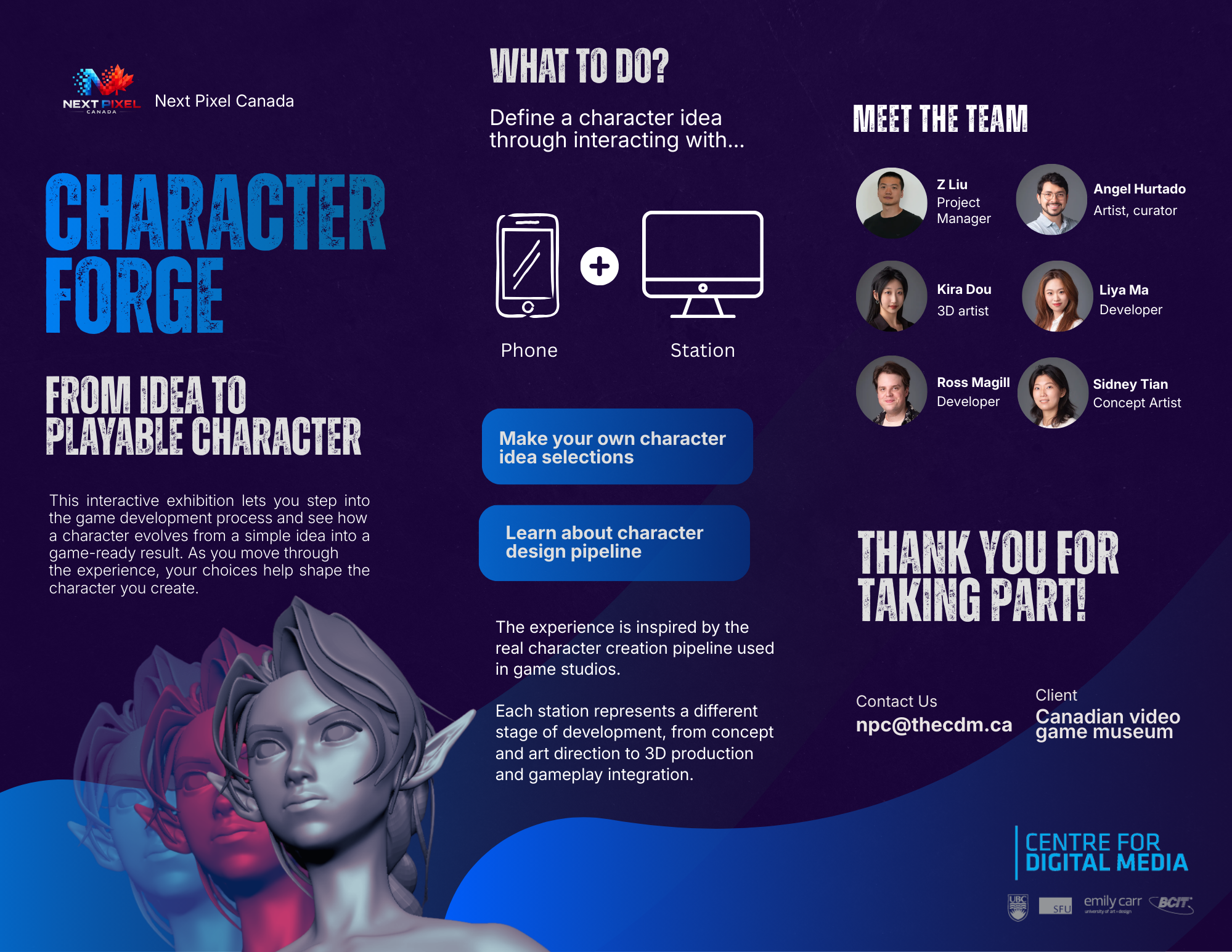
Visitors take a character through four stations, each representing a department in a game studio. At each station, the visitor makes decisions on their phone, and the station shows what happens when that department receives those choices and executes on them.
Character Concept
Visitors decide what their character does, how players should feel about it, and what it fears. These three answers produce one of twelve archetypes, and a choice of visual fidelity sets the production constraints for everything that follows.
Concept Art
Visitors explore shape language, outfits, props, and color, ending with a character turnaround.
3D Production
Visitors sculpt, then see retopology, UV unwrapping, and baking before texturing, shading, rigging, and animating their character.
Gameplay Integration
Visitors control their character in a shared multiplayer sandbox while adjusting its animation states, level of detail, runtime systems, and stats from their phone.
Decisions
The biggest decision was how to move visitor data between stations. The brief suggested NFC on visitors’ own phones, but reading and writing NFC from a phone’s web browser only works in Chrome on Android, and the exhibit needed to work on iPhones too. Instead, we made the visitor’s phone a bridge. Each station’s choices are encoded into a URL, turned into a QR code, and scanned by the next station’s webcam. This meant that there was no app download, no account, and no server required since we wanted to reduce friction for visitors.
- The phone is where the visitor gives direction, and the station is the department that performs the transformation.
- Stations stay passive while visitors use their phones, so several people can start at once without competing for the screen.
Prototypes
This was a very exploratory project with many iterations and prototypes. CVGM weren’t necessarily asking us for a final product to implement into their museum, but rather to explore multiple paths of potential exhibits within the character pipeline theme that they had yet to look at. As such, much of our work was building prototypes to test different ways each station could work.
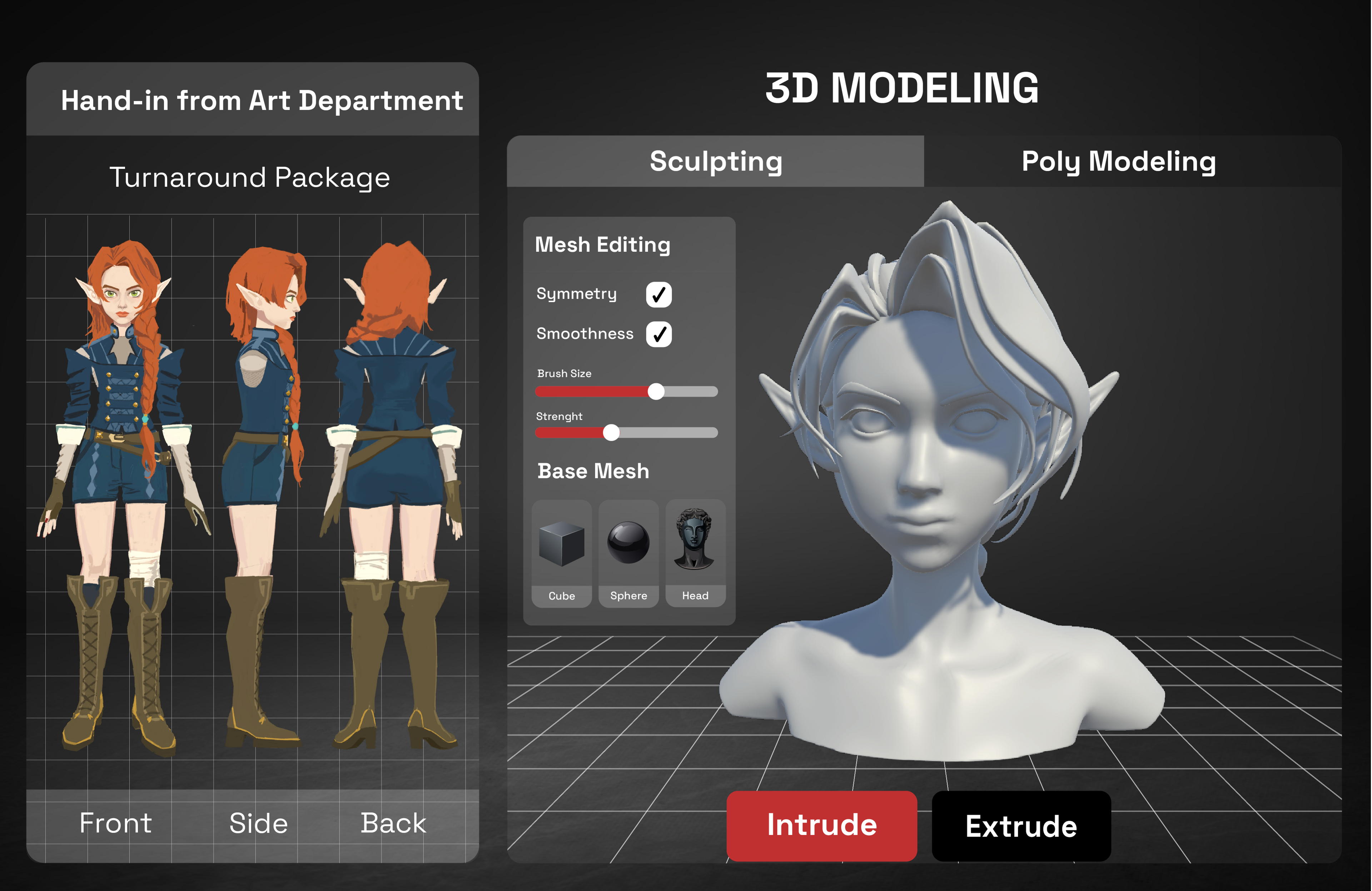
- Unity scene prototypes: flip book, Duolingo-style line tracing, Station 1 prompts, scratch-away art reveal, 3D sculpting, and a block-chiselling 3D model scene.
- Hardware: I built the physical input prototypes, with an Arduino reading a rotary encoder and an NFC/RFID reader (PN532 over SPI), sending messages to Unity over USB serial.
- Web app: the phone experience was built in React by myself and Liya, and hosted on Netlify.
Outcome
We delivered a master design document covering all four stations, along with the working prototypes. Because the brief asked for a clear path to a polished exhibit, I also built the technical documentation for the handoff including a master technical design document linking separate sub-documents for each Unity scene, each hardware component, and the web app, plus a Unity Action Plan explaining how the exhibit could be built out with more development time.
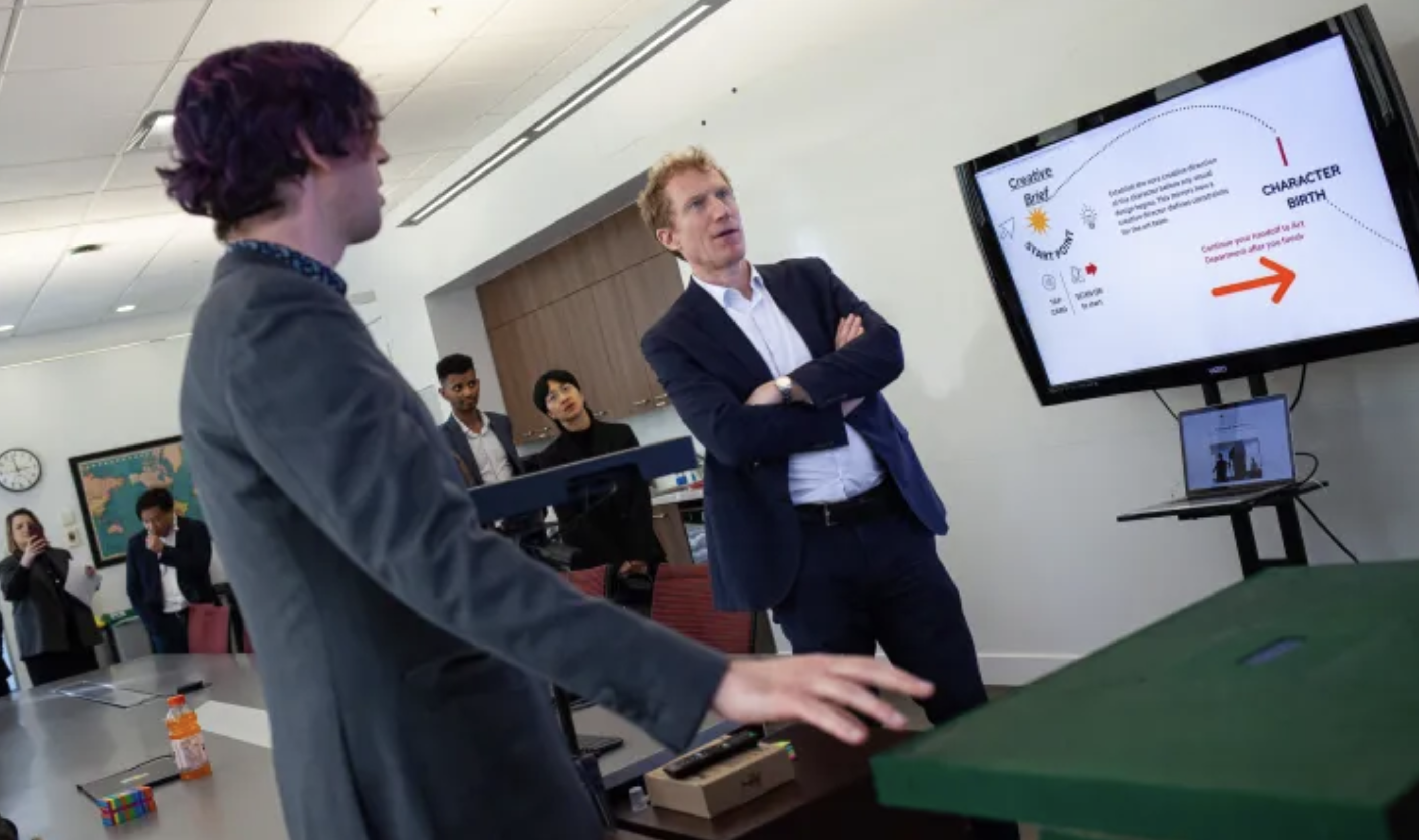
It was received well by CVGM, who are continuing to develop the project so it can be implemented in the museum for the public. The exhibit prototype was shown to the Honourable Marc Miller, Minister of Canadian Identity and Culture and Minister responsible for Official Languages, who enjoyed learning about the pipeline and the industry.
This project was very different for me and allowed me to exercise some design muscles that I didn’t know I had. While museum exhibits represent their own distinct category of design, the lessons I learned here taught me things about game design that I hadn’t considered before. For example, keeping stations passive while visitors use their phones taught me to design for many people sharing one space at once, which is the same problem multiplayer and couch co-op games have to solve.